
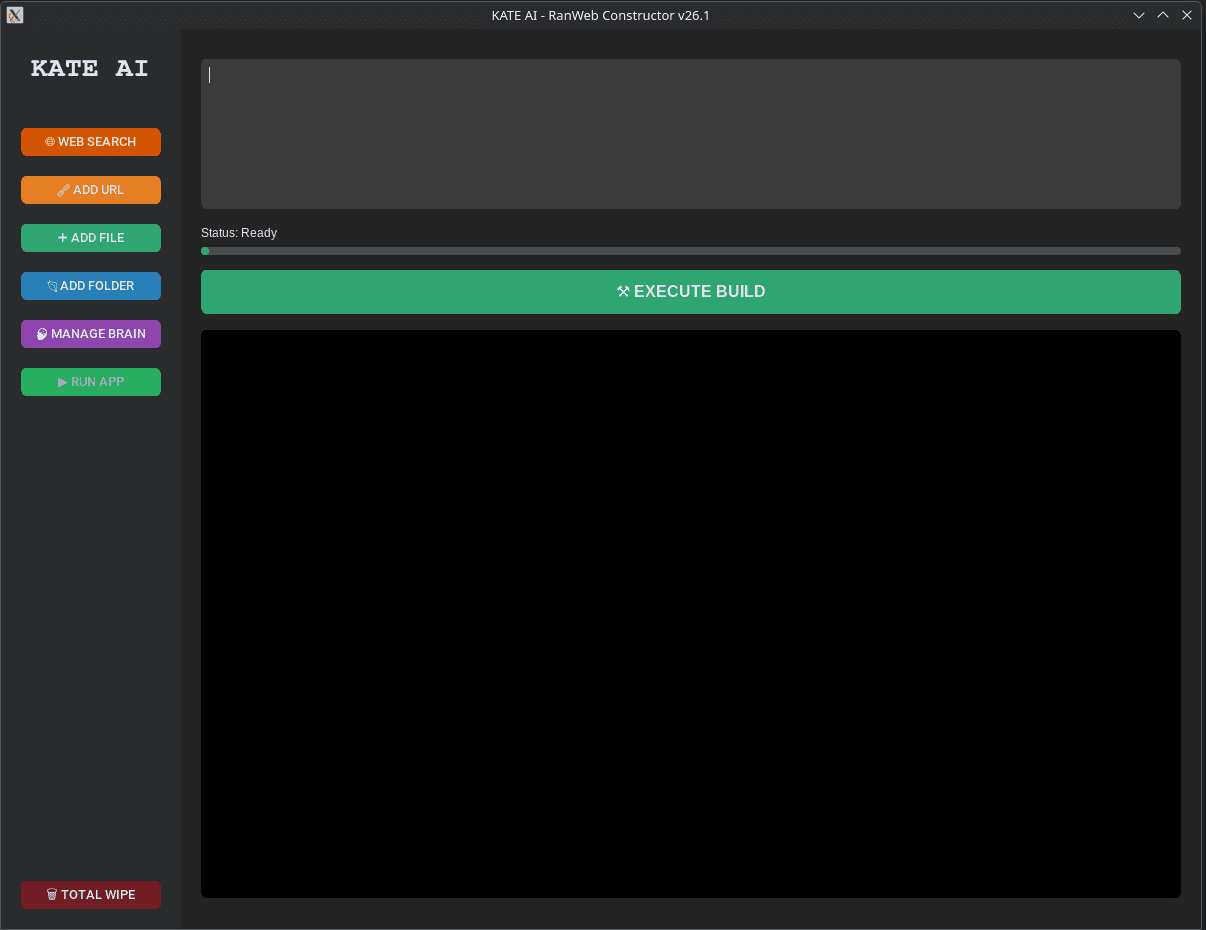
Beyond the Chatbot: Why I Built KATE AI to Architect My Linux Workspace
I’m tired of AI being used just for “chatting.” I wanted a collaborator that actually does the work. That’s why I developed KATE AI (Kinetic Automated Technology Engine). KATE isn’t just an LLM interface; she is a Generative Construction Hub running natively on my Debian Linux system. She doesn’t just suggest code—she architects, saves, and launches entire applications directly onto my desktop.
What makes KATE AI different?
Most AI interactions end in a copy-paste loop. KATE breaks that cycle with a few key “Architect” features:
- The “Brain” Integration: I’ve given KATE a local knowledge base. By feeding her documentation and technical books, she understands the specific context of the projects I’m building before she writes a single line.
- Live Generative Construction: Using a custom “Clean Stream” terminal, I can watch KATE “type” the application in real-time. It’s not just a progress bar; it’s a live view into the machine’s logic.
- The Auto-Launch Loop: This is the “Magic Moment.” Once KATE finishes the build, she automatically saves the file to my local directory and executes the program. I go from a prompt to a functioning UI (like my new project, RanWeb) in seconds.
Solving the “Real World” Linux Challenges
Building a “Builder” came with its own set of technical hurdles. We had to solve:
- Subprocess Sanitization: Overcoming
ValueErrorcrashes caused by binary data in the knowledge base by moving to a File-Injection model. - Unbuffered Heartbeats: Ensuring the UI stays responsive and the progress bar stays synced even when the CPU is at 100% load.
- Dependency Injection: Managing PyQt6 and Chromium engines so the apps KATE builds are professional-grade and secure.
The Big Picture
KATE AI represents a shift in how we use local LLMs (like Ollama). We are moving away from “AI as a toy” and toward “AI as a System Architect.” I’m currently using KATE to build RanWeb, a private, hardened browser, and the speed of development is unlike anything I’ve experienced before.
Software is no longer just about writing code; it’s about orchestrating the build.